Creative is the single biggest driver of sales, and your biggest opportunity to grow
Ask most local business owners what makes advertising work, and you’ll hear about the same handful of things: the right station or platform, the right audience, enough frequency, the best price. Almost no one leads with what actually moves the needle most: the quality of the ad itself. And that blind spot is expensive.
New research from the Cumulus Media | Westwood One Audio Active Group®, drawing on data from Circana, puts a number on it. Across nearly 450 advertising campaigns. The creative (the message, the writing, the production, the idea) drove 49% of all incremental sales. Marketers think it’s worth less than half that. This is the most consequential gap in advertising, and most of the money in the room is being spent as if it doesn’t exist.
The Data: Creative Does The Heavy Lifting
For the past seven years, Westwood One has partnered with Advertiser Perceptions to ask marketers and media agencies what percentage of advertising sales is driven by five factors: brand, creative, reach, recency, and targeting. Their answers must total 100%. In February 2026, responses from 304 marketers and agencies were compared to Circana’s Five Keys to Advertising Effectiveness, a decade-long study of nearly 450 campaigns. The gap between perception and reality was significant.
Perception versus reality: the five sales drivers
| Sales driver | Perception | Reality | Gap |
| Creative | 23% | 49% | Under by 2.1x |
| Brand | 20% | 21% | Accurate |
| Reach | 21% | 14% | Over by 1.5x |
| Targeting | 22% | 11% | Over by 2.0x |
| Recency | 14% | 5% | Over by 2.8x |
Sources: Perception: Advertiser Perceptions, February 2026 (304 marketers and media agencies). Reality: Circana, Five Keys to Advertising Effectiveness, 2023.
Read the table from the top, and the story tells itself. Marketers rank creative roughly even with targeting and reach, a nice, democratic spread where everything matters about the same. The reality isn’t democratic at all. Creative isn’t one of five roughly equal levers; it is nearly half the engine. Everything else combined accounts for the other half.
Why Marketers Get This So Wrong
“Marketers spend far too much time worrying about anything but the one single-handed thing that could change their business that quarter: creative effectiveness,” says Andrew Tindall, Chief Growth Officer at System1, a leading creative-testing firm. “We need to be bold, unapologetically say no to things to get time to make better ads, and partner with the right agencies that bring the talent, tools, and knowledge to make work that works.”
This isn’t a lone finding. Nielsen’s analysis of nearly 500 campaigns reached almost the identical conclusion years earlier, attributing 47% of sales to creative, more than any other element. Analytic Partners, a leader in media-mix modeling, calls creative “a key driver of advertising performance, second only to investment levels.” When the three biggest names in advertising measurement independently land on roughly the same number, it stops being an opinion.
Boring Ads Cost More, Literally
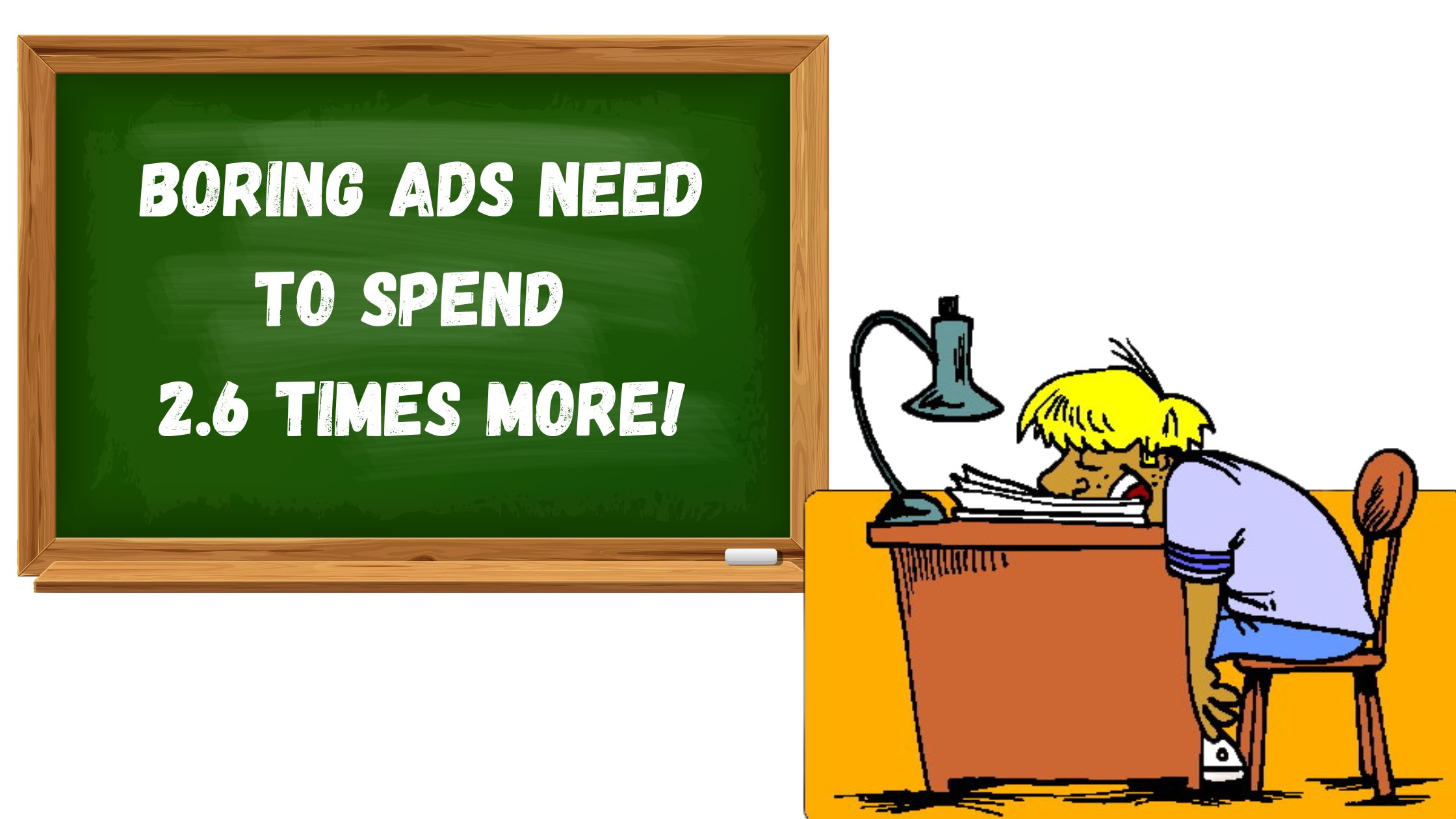
If great creative is upside, dull creative is a tax. Research from System1 with Peter Field and Adam Morgan, The Extraordinary Cost of Dull, quantifies exactly what forgettable advertising costs. Boring ads need to spend 2.6 times more to achieve the same market-share growth as interesting ones. Put the other way: interesting, emotional ads generate 6.1 times more share growth than dull, rational ones. In one documented case, a single dull UK campaign had to spend roughly £10 million more than an engaging campaign to reach the very same commercial result.
And dullness is the default. The research found that 52% of ads leave people feeling nothing at all, rising to 60% in B2B. For a local advertiser, that’s the real competitive set: a sea of forgettable messages. The fastest way to out-perform a bigger budget isn’t a cleverer media buy. It’s an ad people actually remember.
The Lever Almost No One Pulls
Marc Binkley of the marketing consultancy Quatical puts it about as plainly as it can be put: “Creative is the closest thing we have to a silver bullet…it’s a way to supercharge budgets. Emotional, well-branded creative is a way to be more memorable.” That word, supercharge, is the point. Better creative doesn’t require a bigger budget. It makes the budget you already have work harder, often dramatically so.
Which raises the uncomfortable question for any business buying advertising right now: if creative drives half of sales, how much of your time, attention, and budget is actually going into the ad itself, versus the media plan around it?
The Manning Media Take
Here is what that means for you. Most media companies sell you a schedule and treat the ad itself as an afterthought, something to knock out quickly once the buy is booked. We built Manning Media to do the opposite. Your commercial is created by our in-house creative team through a custom production process built around the one thing the research says matters most: crafting an advertisement your customers remember and act on.
That is the difference you feel when you work with us. We still get your message in front of the right people often enough to matter, and we take that part seriously. But we treat the writing, the voices, the production, and the idea as the strategy, not the leftover. A commercial built this way stretches every dollar of your buy further, because a message people actually remember keeps working long after the schedule ends. That is the opportunity in front of every local advertiser right now, and it is exactly where we go to work for you.
Coming Next in Part 2
If creative is the half of the budget most advertisers ignore, the obvious next question is how to get it right. In the second post of this series, we’ll get practical: branding early and often, the case for humor, and the specific things that separate the ads people remember from the 76% nobody does.